
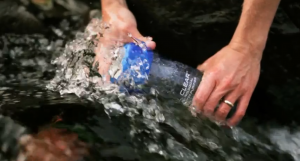
When it comes to basic survival needs—like potable water—it is irresponsible to recommend a product based on anything less than functionality. So we are not recommending the CamelBak All Clear UV Microbiological Water Purifier, because haven’t tested it. (Yet.) We can only say this: if it reliably does what it claims it can do, it’s an appealing alternative to cumbersome water filtering systems and chemically treated (and often foul-tasting) purification tablets.
And—without recommending it—we have to admit that it has a very cool design. So yes, based on its outward appearance alone, we are kind of in love.
The All Clear is a .75 liter water bottle that uses a rechargeable battery to power an ultraviolet-C lightbulb, which is designed to kill the microorganisms that can leave you curled up in pain when you were planning to be hiking or biking or watching the waves lick up along an Indonesian beach. Fill up the bottle, hit the button, gently agitate the water. The timer clicks off 60 seconds, after which the water is potable. If the water source has debris and sediment, you can install a filter that will screen out the big bits.
The cap weighs 7 ounces, so it isn’t ultralight, especially compared to a handful of purification tablets. And it isn’t cheap: it costs $99.99, and the pre-filter is an additional $15.00. But if you’re willing to shoulder it—literally and financially—you get a lot:
- The virtual elimination of bacteria (99.9999 percent), viruses (99.99 percent) and protozoa (99.9 percent). (Actually, UV-C doesn’t kill the little beasts. It destroys microbe DNA, which prevents reproduction, which renders them harmless.)
- The device delivers 80 or more cycles on a charge, so three bottles a day for 26 days.
- The bulb is supposed to give you 10,000 cycles, or three bottles a day for the next nine years.
- Recharging the batteries (with a USB cord) takes about five hours off a wall socket and up to 20 hours off a solar panel.
We believe in the technology. The bug-slaughtering capabilities of UV light have been known for over a century. (Or, as we say, longer than Robert Marchand has been alive.) In 1903, Faroese-Danish physician and scientist Niels Finsen received a Nobel Prize for using UV light to against tuberculosis.
The technology does have limits, though. Particles in water will block the light, and any nastiness lurking within those chunks will be protected from the killer UV rays. (Hence, the filter.) UV light also doesn’t go through the air bubbles or impurities in ice. And the batteries don’t perform up to specs when the temperature dips below freezing.
And then there is this: one reason to go back into the woods is to put aside all the technology of modern life and reconnect with that lizard brain deep in your cortex. That means less of everything, especially everything that has an LED display. It means boiling your water rather than letting a lithium-ion battery do the work. And that’s OK in the woods. Back in the world, though, a lot of hotels frown on you boiling your own water. And we’ve had gut-wrenching (literally) Delhi Belly and Montezuma’s Revenge and whatever you call what happens to you in Rangoon. And we’ve had a kid come down with giardia. After that, we don’t care how it gets done, we just want those little microbes dead. Quickly, conveniently, and thoroughly (99.9999 percent) dead.
Image: screen grab from CamelBak’s All Clear promotional video